Author Highlight

Eddie Visnovske – Wolf Light Leadership Consulting, Columbia Falls MT
As a leadership consultant and coach, most of my meetings today are one-on-one conversations with leaders and teams. I enjoy them. That was not always the case.
Before coaching, I spent 30 years as a park ranger with the federal government. And yes, park rangers have meetings too. Some were productive. Some were not.
Sound familiar?
Your team has a lot going on. Communication is essential, so you gather everyone in one room to share updates, coordinate work, and discuss next steps. The meeting starts well enough, but questions begin piling up. Different opinions emerge. A few people dominate the discussion while others disengage. Before long, the group shifts from sharing information to trying to solve problems on the spot.
Time runs out. Little gets decided. As people leave, you overhear comments like: “We just keep talking in circles.” and “That’s two hours I’ll never get back.”
What happened?
In many cases, the meeting lost sight of its purpose. Was it meant to exchange information or solve a problem? Those are two very different meeting types, and when they become mixed together, progress often slows to a crawl.
Start with the Purpose
Good meetings rarely happen by accident. They require planning, structure, and a clear goal. State the purpose in the invitation and again at the start of the meeting.
Information Exchange Meeting
“The purpose of this meeting is to exchange updates on the X project. Please be prepared to provide a two-minute summary of your area.”
Solution-Making Meeting
“The purpose of this meeting is to develop a solution to the X problem. Please bring any information or resources that may help identify the best path forward.”
When participants understand the destination, they’re more likely to stay on course.
Invite the Right People
Not everyone needs to attend every meeting.
Including people who are not directly involved may seem inclusive, but it often leads to disengagement or discussions that drift away from the issue at hand. Match attendance to the meeting’s purpose.
Use an Agenda
No agenda, no meeting.
An agenda does not need to be complicated, but it provides structure and keeps conversations focused. Without one, meetings often follow the strongest personalities in the room rather than the intended outcome.
Choose a Facilitator
Knowledgeable but neutral is best.
The executive director, board chair, or senior leader is often expected to run the meeting. In practice, that is not always ideal.
Facilitating, contributing ideas, and making decisions at the same time can be difficult. A facilitator who understands the topic but remains neutral is often more effective at keeping the group focused and productive.
Some organizations hire facilitators. Others develop internal capacity or create facilitator exchanges with trusted leaders from other organizations.
Capture Notes and Action Items
If a discussion is important enough to have, it is important enough to document.
Notes should capture key decisions, important information, and especially action items. Every action item should be clearly assigned so participants know who is responsible for what happens next.
Document key decisions and clearly assign action items.
Types of Meetings:
The Information Exchange Meeting
The purpose of an information exchange meeting is to keep information flowing across the organization.
Characteristics:
Focused on status updates and notifications
Occurs regularly
Reinforces organizational roles and responsibilities
One person speaks at a time while others listen
Questions are saved for the end or placed in a “parking lot”
Brief updates and visual aids work well
Attendance can be flexible based on relevance
Common Pitfalls:
Inconsistent formats
Withholding important information
Getting pulled into problem solving
The Solution-Making Meeting
The purpose of a solution-making meeting is to solve a problem or reach a specific outcome.
Characteristics:
Focused on decisions and problem solving
Involves subject matter experts and key stakeholders
Works best with approximately 5-7 participants
Follows a defined problem-solving process
Encourages participation from everyone involved
Common Pitfalls:
One or two people taking over
Participants disengaging
Jumping to solutions without following a process
Avoid the Trap
The most common meeting trap occurs when an information exchange meeting drifts into an impromptu solution-making session.
A simple question can trigger a lengthy discussion. Before long, the group is trying to solve a complex problem with the wrong people, too little preparation, and not enough time.
When this happens, resist the urge to chase the discussion.
Capture the issue, place it in the parking lot, and schedule a dedicated solution-making meeting with the right people.
Ideally, these two meeting types should be completely separate. When that isn’t practical, use a clear agenda, take a break between sections, and treat the second meeting as a distinct event with a new purpose.
Even high-performing teams can fall into this trap. The key is recognizing when a meeting has drifted away from its intended purpose and getting it back on track.
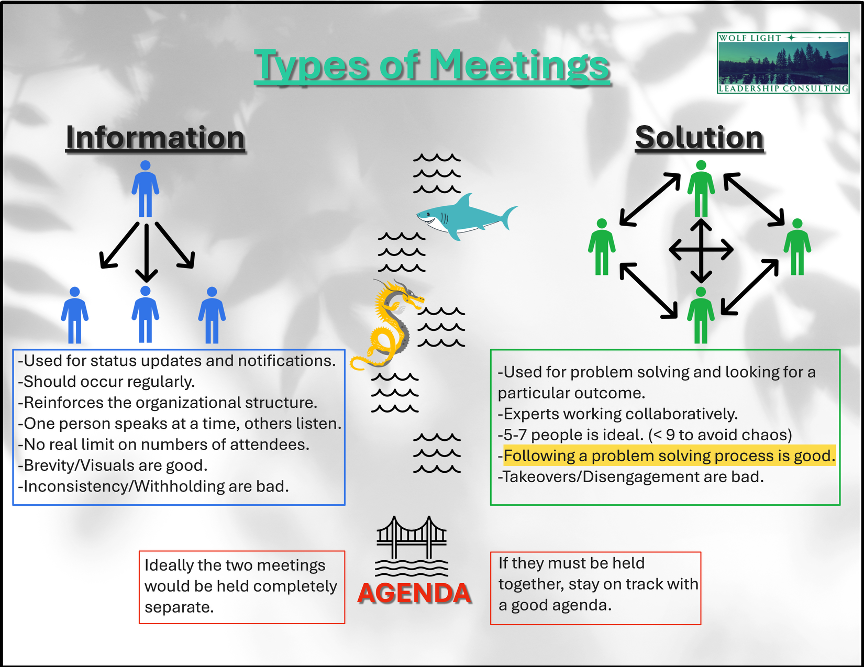
Never cross the moat from one meeting to the other, “Here be dragons!” If you have to connect the two meetings, use a solid agenda to stay on track.
You May Also Like
April 28, 2026
MNA is thrilled to introduce thirteen Rural Ambassadors this year! Ambassadors work to help connect…
September 17, 2026
A practical resource for rural nonprofit and community leaders Cassie Coburn – Meagher County Stewardship…