
Supporting nonprofits in state contracting continues to be a priority for MNA. We know that contracts can be complicated, and we want to make sure our members have the information and support you need to successfully partner with the state. That means working closely with state officials, building our own understanding of the process, and advocating for improvements that make contracting simpler, clearer, and more accessible for nonprofits.
Recently, MNA met with Montana’s State Procurement Services Division (SPSD), part of the Department of Administration (DOA). Here are some of the things we learned about the process. For those that are new to state contracting, we hope this is helpful clarification.
Role of DOA vs Agencies in Procurement:
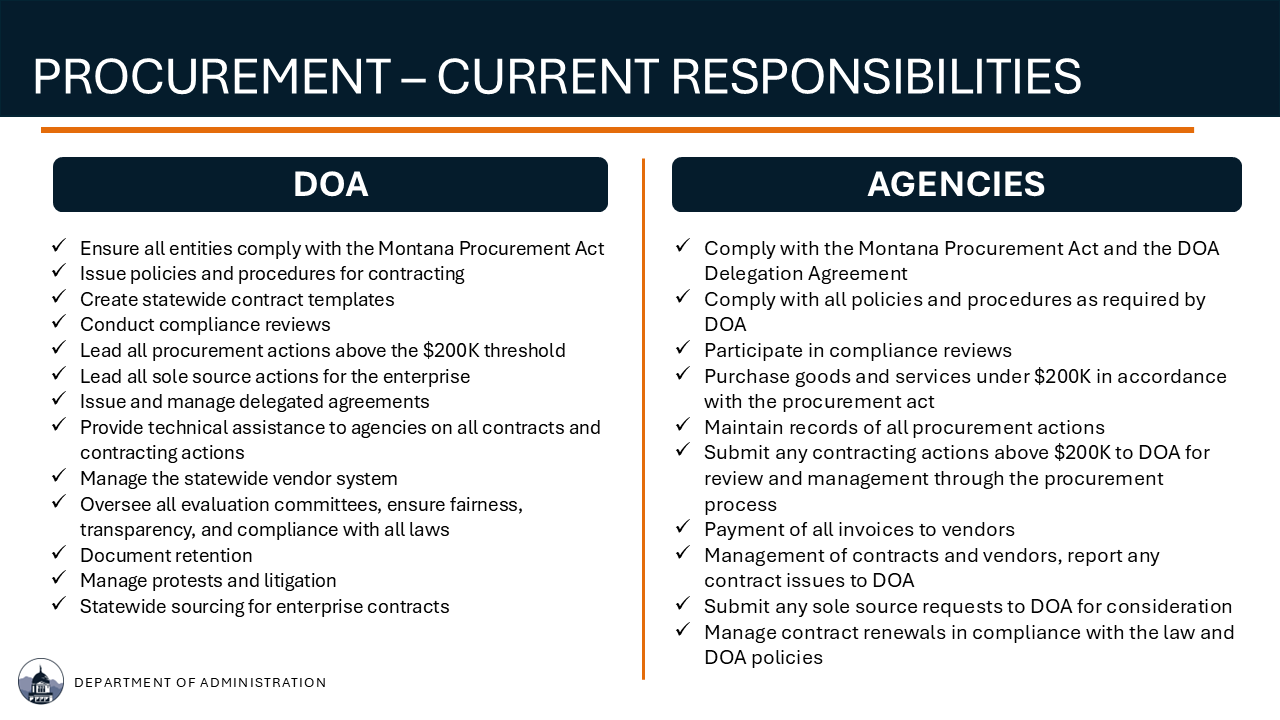
- DOA ensures compliance with the Montana Procurement Act, and provides procurement forms and templates to agencies, standardizing solicitation and contracting processes.
- Agencies (DPHHS, Department of Labor, etc.) also have discretion and involvement in the procurement process. Depending on the size of the agency, they can handle smaller procurements internally, before being required to submit the solicitation and contract through DOA, up to $100,000 or $200,000 depending on the agency. Each agency has its own procurement contact that can provide greater detail on the processes and priorities of procurement within the agency.
- What’s changing: With the recent move to centralize procurement under DOA, the SPSD team will be adding new staff to create greater consistency, reduce duplication, and streamline processes across agencies. Approximately 20-25 procurement staff from state agencies will transition to DOA.
Grants vs Contracts:
- Contracts fall under the state’s procurement rules and follow the State of Montana Procurement Manual. Contracts can be solicited as Requests for Proposals (RFPs) or Invitation for Bids (IFBs).
- All contracts awarded under the Montana Procurement Act can be found on the DOA website.
- DOA posts a Procurement Forecast, where you can view anticipated solicitations for the year.
- Grants are treated differently than contracts and can operate outside of the procurement system. They typically involve the state awarding funds to an organization or unit of government that then re-grants those dollars to others.
Intent to Sole Source:
Sometimes agencies believe only one provider can meet their needs and fulfill a contract. In these cases, they can request to “sole source” a contract. However, they are still required to post these notices on eMACS (the state e-procurement system) for 10 days, allowing others to consider whether they meet the contract requirements.
Cooperative purchasing:
The state has cooperative purchasing agreements that allow eligible entities to buy supplies at reduced costs. There may be opportunities for nonprofits with state contracts to participate in these purchasing agreements. MNA will dig in further and share more details as we learn them.
What’s Next
State contracts will remain a focus for MNA – and for the state. In the coming months, the state will be implementing HB 627 and SB 564, both intended to increase transparency and accountability in procurement.
We also encourage you to keep an eye on HJ 42, an interim study on procurement and no-bid contracts led by the Legislative Audit Committee. We’ll be following this study closely, making sure the input, feedback, and ideas of nonprofits are part of the conversation.
Share Your Input: We know that state contracting is complex and there is a lot for us to learn. If you have ideas for how Montana can make contracting work better for nonprofit partners and the communities you serve, please reach out to Lorianne at lburhop@mtnonprofit.org.